
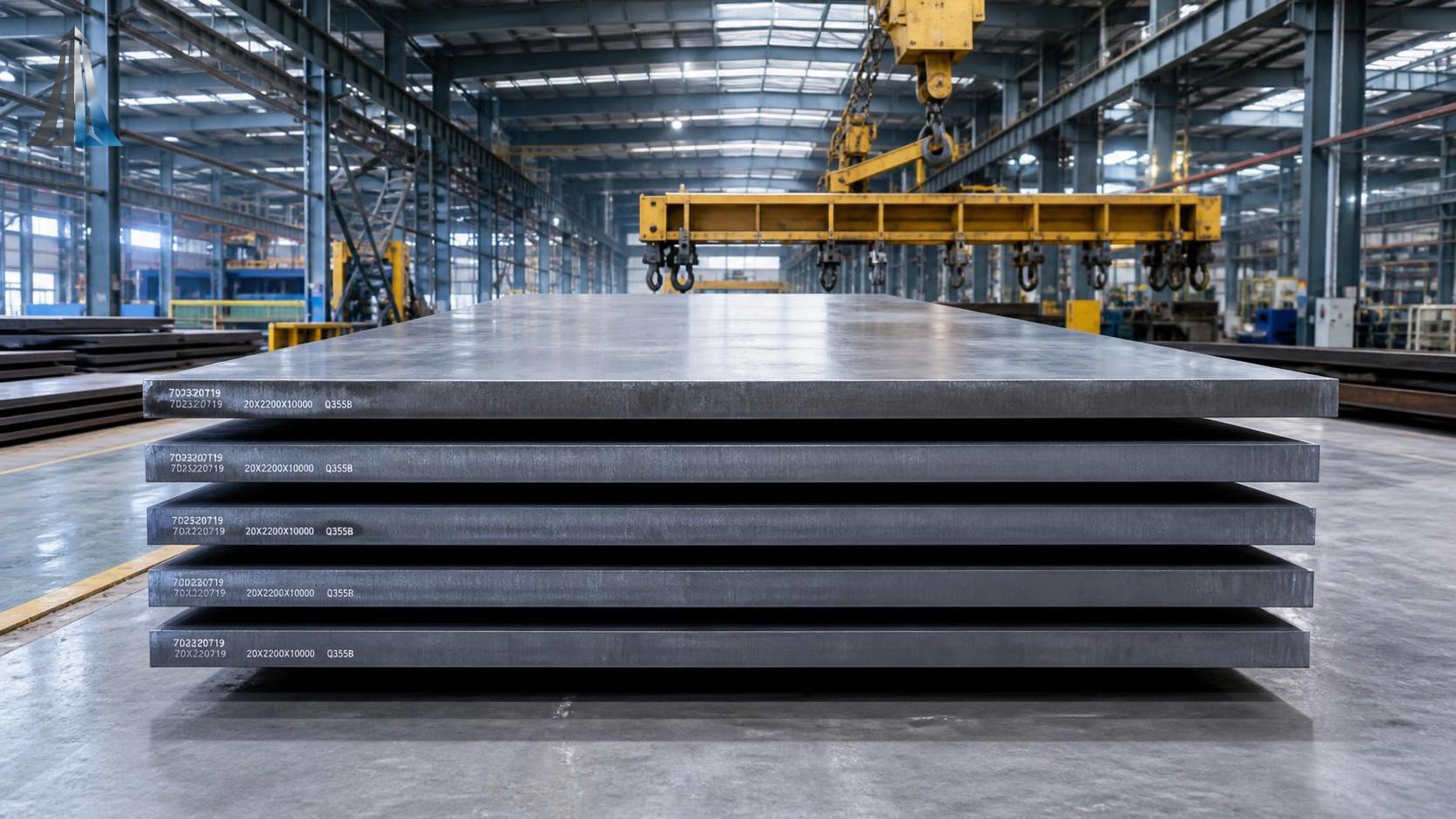
What really matters when a pressure vessel plate is ordered for export
For export projects, buying a Pressure Vessel Steel Plate is rarely a simple steel purchase. The plate may look similar on paper across several mills, but the export risk sits in the details: which standard applies, whether the grade is normalized or thermomechanically rolled, what the inspection scope is, and whether the documentation package will actually satisfy the destination market, end user, fabricator, and third-party inspector.
That is where many procurement problems begin. A plate can be technically usable for fabrication and still become a problem at customs clearance, during welding procedure qualification, or at final dossier review. In pressure equipment work, the standard printed on the mill certificate is not a formality. It affects chemistry, tensile properties, impact testing, heat treatment condition, marking, traceability, and often the buyer’s legal responsibility.
For companies sourcing through regional trading and processing hubs such as Vietnam, this becomes even more practical. Firms like Summit Metal Group Co., Ltd. (SMG), working across carbon steel and industrial export supply chains, typically have to balance mill source, processing capability, shipping schedule, and destination compliance at the same time. In that setting, the “right plate” is the one that matches both engineering need and document expectation.
The standards buyers ask for most often
In international trade, pressure vessel plate demand usually centers around a few major systems rather than a single global standard.
ASTM/ASME grades are common in projects connected to North America, the Middle East, and many EPC specifications written around ASME design codes. In this route, buyers often refer to ASTM material grades such as ASTM A516, while the vessel design side may reference the corresponding ASME material specification. The practical issue is not just naming. Purchase orders need to be clear about whether the plate is required under ASTM production and testing terms, ASME code acceptance, or both.
EN standards are widely used in Europe and in export projects where PED-related documentation or European fabrication practice is involved. EN 10028 is one of the core reference families for flat products for pressure purposes, with different parts covering non-alloy and alloy steels. Here, buyers need to watch the full designation, not only the strength level. The testing condition, impact temperature, and delivery condition can change the plate’s suitability considerably.
JIS grades also appear in Asian industrial supply chains, especially where Japanese design influence remains strong. DIN legacy references still surface in older project documents, though in many cases they need to be translated carefully into current EN equivalents or project-approved alternatives. That conversion should never be assumed without technical review.
A grade name is not enough
One of the most common buying mistakes is treating the grade designation as the entire requirement. It is not.
Take ASTM A516 as an example. Many buyers know the difference between Grade 60, 65, and 70 in terms of strength, but the export issue often sits elsewhere: plate thickness range, notch toughness requirement, heat treatment expectation, and supplementary requirements. If the fabricator needs low-temperature performance or the project specification calls for impact testing, the purchase order must state that clearly. Otherwise, a mill can deliver a compliant basic grade that still does not satisfy the actual vessel service condition.
The same applies to EN plates. A designation like P265GH or P355GH tells you something, but not everything. Delivery condition, test temperature, ultrasonic testing requirement, and certification level may all need to be stated separately. In real export documentation review, omissions here create more delays than obvious grade mismatches.
The standards behind the paper trail
Procurement teams often focus on the product standard first, which is sensible, but the documentation standard deserves equal attention. For many export orders, EN 10204 certification type becomes a key checkpoint. If the contract calls for 3.1 or 3.2 inspection documents, that requirement should be fixed before production, not discussed after the plate is ready to ship.
This is especially true when third-party inspection is involved. A buyer may assume that a standard mill test certificate is enough, while the end user expects witnessed tests or dual sign-off under a more stringent inspection route. By the time that gap is discovered, replacement is expensive and delivery dates are already under pressure.
Traceability matters just as much. Heat number, plate number, stamping or low-stress marking, and the link between physical material and certificate must remain intact through cutting and processing. If the exporter provides cut plates rather than full mill plates, the way traceability is transferred becomes part of compliance, not just warehouse administration.
Where export orders usually go wrong
In practice, trouble rarely comes from dramatic technical failure. It usually comes from small mismatches between the project file and the purchase file.
- The order states the material grade but not the edition of the standard.
- The buyer assumes normalized plate, but the mill quotes another delivery condition.
- Impact testing is expected by the fabricator but not written into the PO.
- The certificate format does not match the project’s inspection document requirement.
- Supplementary NDT, such as ultrasonic testing, is discussed informally but never contracted.
- A substitute grade is offered as “equivalent” without end-user approval.
None of these errors are unusual. They happen because export steel purchasing sits between engineering language and commercial language. The people negotiating freight, lead time, and payment terms are not always the same people checking impact energy values or code references.
Equivalent grades: useful, but risky if handled casually
Cross-standard comparison is part of global steel trading, but “equivalent” should be treated as a technical starting point, not a commercial shortcut. A plate sold as comparable to another grade may be close in yield or tensile strength, yet still differ in chemistry limits, test regime, carbon equivalent, weldability behavior, or pressure equipment acceptance.
This matters when a project specification is tied to a design code, regulator, or approved vendor list. Even if a substitution seems reasonable from a metallurgical standpoint, the project may reject it simply because the documentation chain is different. On export orders, that kind of rejection is costly because the material may already be on water when the comment comes back.
A safer approach is to separate three questions: is the material mechanically comparable, is it code-acceptable for the project, and is it contractually approved by the buyer or end user? Those are not the same question.
Inspection and supplementary requirements that deserve early attention
For pressure vessel plate, the base standard often does not cover every project expectation. Supplementary requirements may include ultrasonic examination, through-thickness properties for highly restrained welded joints, tighter chemistry control, or specific impact test conditions. Some orders also require hard stamping limits, positive material identification after processing, or preservation rules for export packing.
These details can affect mill selection. Not every source is equally comfortable with additional testing, and not every stockist can preserve clean traceability after cutting. In regional supply chains, where steel may be sourced, processed, and exported through different parties, this point deserves more discipline than many buyers expect.
If the order will be cut to size, bevelled, or blasted before shipment, procurement should confirm whether processing changes the required marking method or document pack. This is a small step, but it prevents one of the classic disputes in export fabrication supply: “the material is right, but the paperwork no longer follows the pieces correctly.”
A practical review checklist before placing the PO
Why source location still matters even when the standard is the same
Two mills can both supply a compliant Pressure Vessel Steel Plate grade, yet the buying experience may be very different. Lead time, familiarity with export documentation, responsiveness during inspection comments, and willingness to align with project-specific extras all affect the final outcome.
This is one reason Southeast Asia continues to matter in industrial metal supply. Vietnam, in particular, is useful not just as a trading location but as a coordination point between mill sourcing, processing, and shipment. For companies such as SMG, which handle broader steel and non-ferrous export flows, that position can help when an order needs more than simple resale, especially if cutting, packaging, consolidation, or mixed-product shipment is involved. That said, the logistics advantage only pays off if the technical review is done properly at the start.
The real buying discipline is document control before material control
In theory, pressure vessel plate purchasing is about metallurgy. In day-to-day export business, it is just as much about document discipline. Buyers who prevent problems usually do one thing well: they translate project requirements into a purchase order that leaves very little open to interpretation.
If the order is for a boiler, vessel shell, heat exchanger component, or other code-sensitive fabrication, it is worth checking the material standard against the design code, the fabrication specification, and the end-user document list before the order is released. That short review can catch the expensive gaps: wrong certificate type, missing notch toughness requirement, unapproved substitution, or unclear processing traceability.
When export schedules are tight, there is a temptation to lock price first and clarify technical notes later. For pressure vessel steel, that sequence usually creates more delay, not less. The plate standard that matters is not only the one the mill can print on the certificate. It is the one the whole project chain will accept without argument when the material arrives.
Recent Articles
 How to Choose Stainless Steel Plate Grades for Corrosion and Fabrication Needs
 Cold Rolled Steel Plate: Key Selection Criteria for Forming and Surface Finish
 When Wear Resistant Steel Plate Lowers Maintenance Cost in Mining
 Pressure Vessel Steel Plate Standards That Matter for Export Orders
 What Causes Surface Cracks in Steel Wire Rod During Rolling
 How to Choose Duplex Stainless Steel Pipe for Chloride Service
Please give us a message